The Executive's Guide to RAG for Enterprise AI
A strategic guide for business leaders on the four evolutionary architectures of RAG — from basic document search to autonomous AI workflows — and how to match the right architecture to the right business problem.
At ThirdAct Labs, as we guide organizations through the complexities of Enterprise AI, the most frequent topic isn’t about which new foundational model was released last week — it’s about how to make these models securely and reliably understand your proprietary business data.
One of the engines driving this capability is Retrieval-Augmented Generation (RAG).
The business value of RAG is simple: it eliminates AI guesswork by forcing the system to rely strictly on your company’s internal documents. However, the way we implement RAG has matured drastically. For executives, CIOs, and business leaders, understanding this evolution is critical — not to write code, but to understand what you are buying, the risks involved, and the level of automation you can realistically achieve.
Here is the collective wisdom of our architecture teams, translated into Strategic Blueprints for business leaders.
Naive RAG: The Basic Search Engine
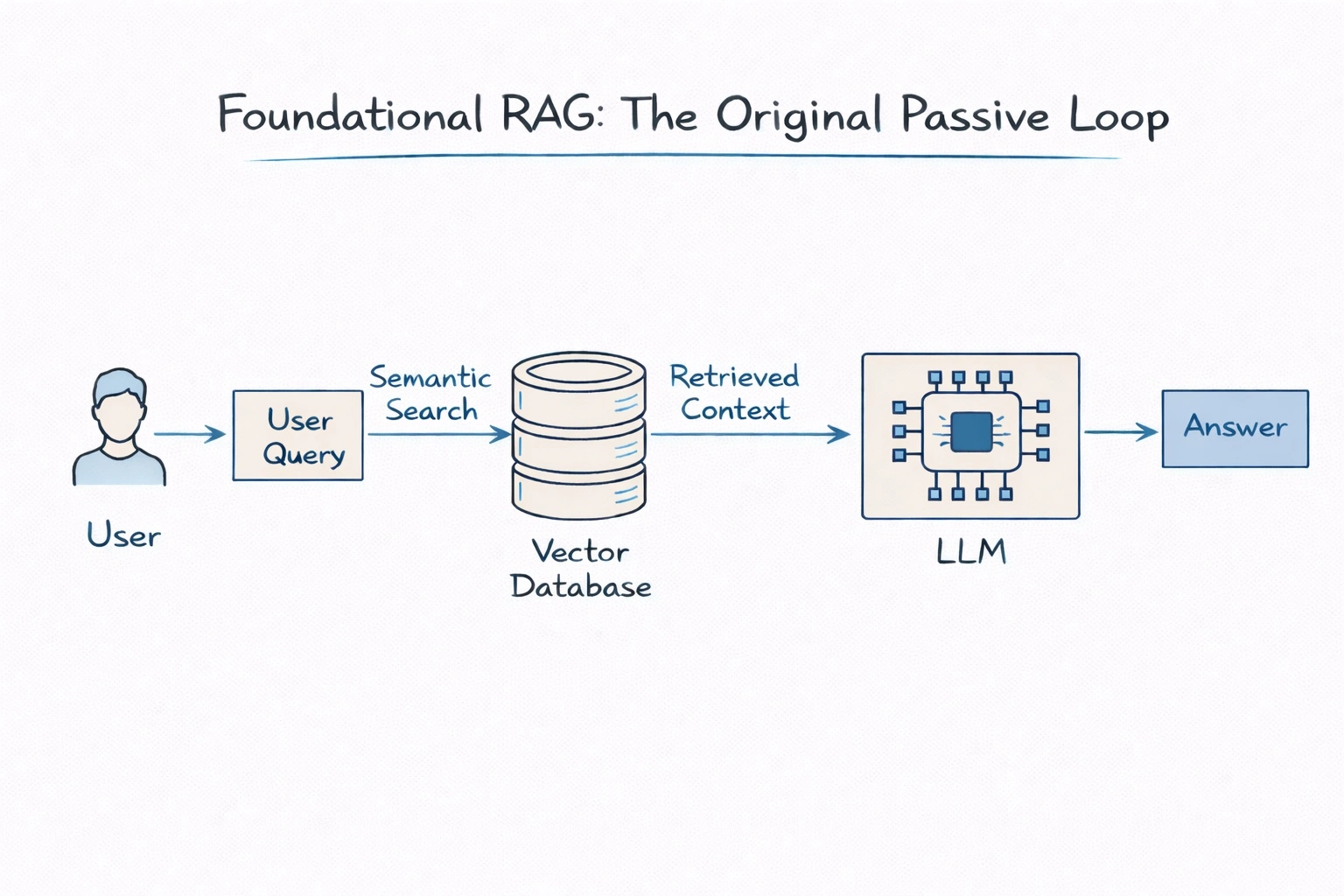
When businesses first attempt to build “ChatGPT for our company data,” they built what the industry calls Naive RAG. It is the quickest path to value, but also the most limited.
The Business Impact
With this architecture, your system acts like a highly literal junior analyst.
-
The Process: A user asks a question. The system runs a quick search through your company documents, grabs the paragraphs that seem most relevant, and hands them to the AI to summarize an answer.
-
The Business Value: Rapid deployment. It solves the “blank page” problem and allows employees to query manuals, HR policies, or past reports quickly.
-
The Risk: It lacks critical thinking. If the initial search pulls up outdated or slightly misaligned information, the AI will confidently synthesize a wrong answer. It cannot recognize when it doesn’t have enough information to solve the problem.
Modular RAG: Built-in Quality Control
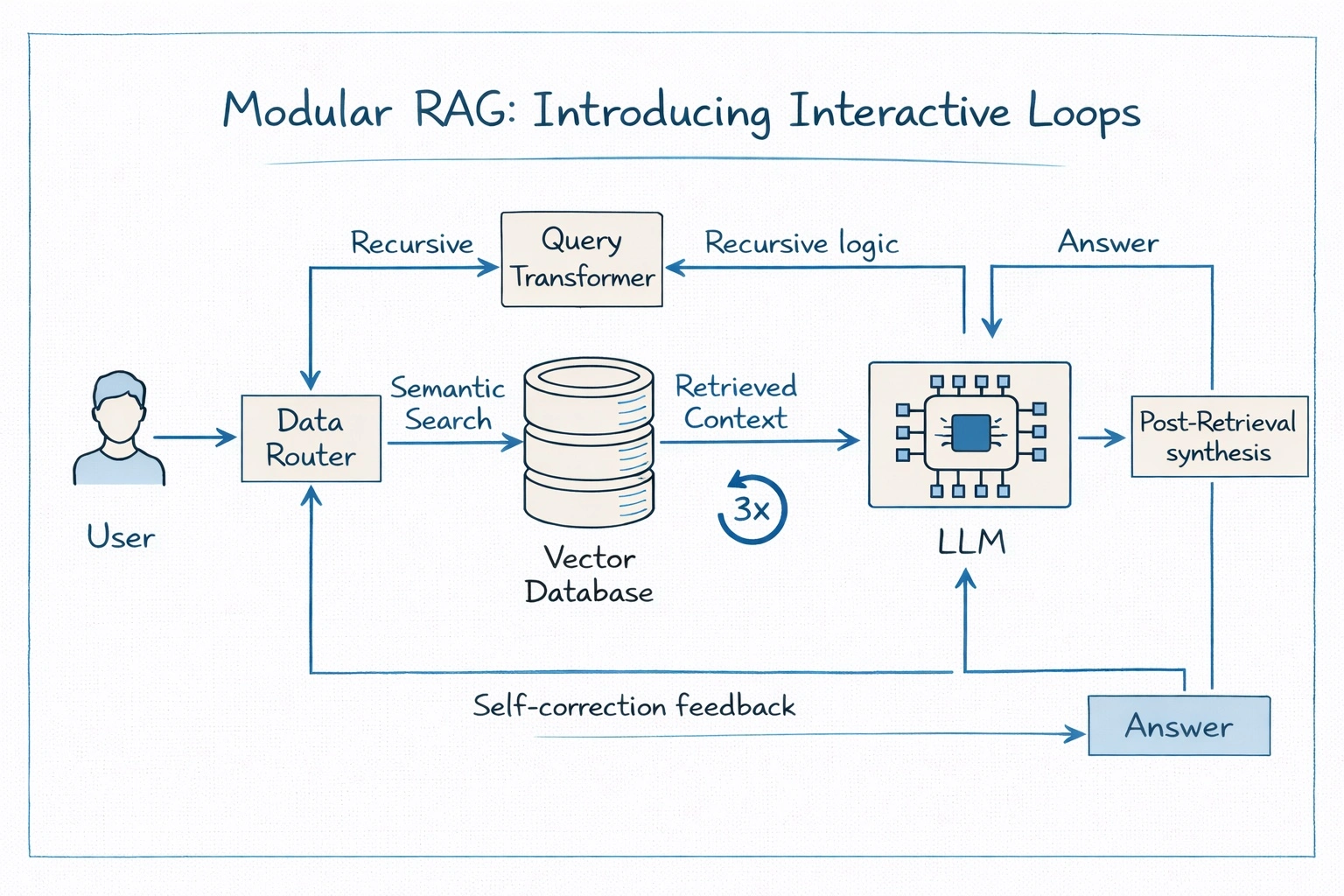
As organizations move AI from internal pilots to customer-facing or high-stakes operational tools, the “Basic Search” is too risky. We had to introduce quality control. This is the Modular RAG.
The Business Impact
Here, the system acts more like an analyst with a supervisor.
-
The Process: We introduce active verification loops. Before delivering an answer, the AI evaluates its own work. Did I find the right data? Does this answer the user’s actual intent? If the answer is no, it automatically re-phrases the search and tries again.
-
The Business Value: Drastically reduced hallucination rates and increased trust. This architecture allows you to safely deploy AI in environments where accuracy matters, such as compliance checking or customer support tier-1 resolution.
-
The Bottleneck: While it rarely gives the wrong answer now, it still struggles to connect the dots across entirely different departments or complex corporate structures.
Graph RAG: Deep Business Context
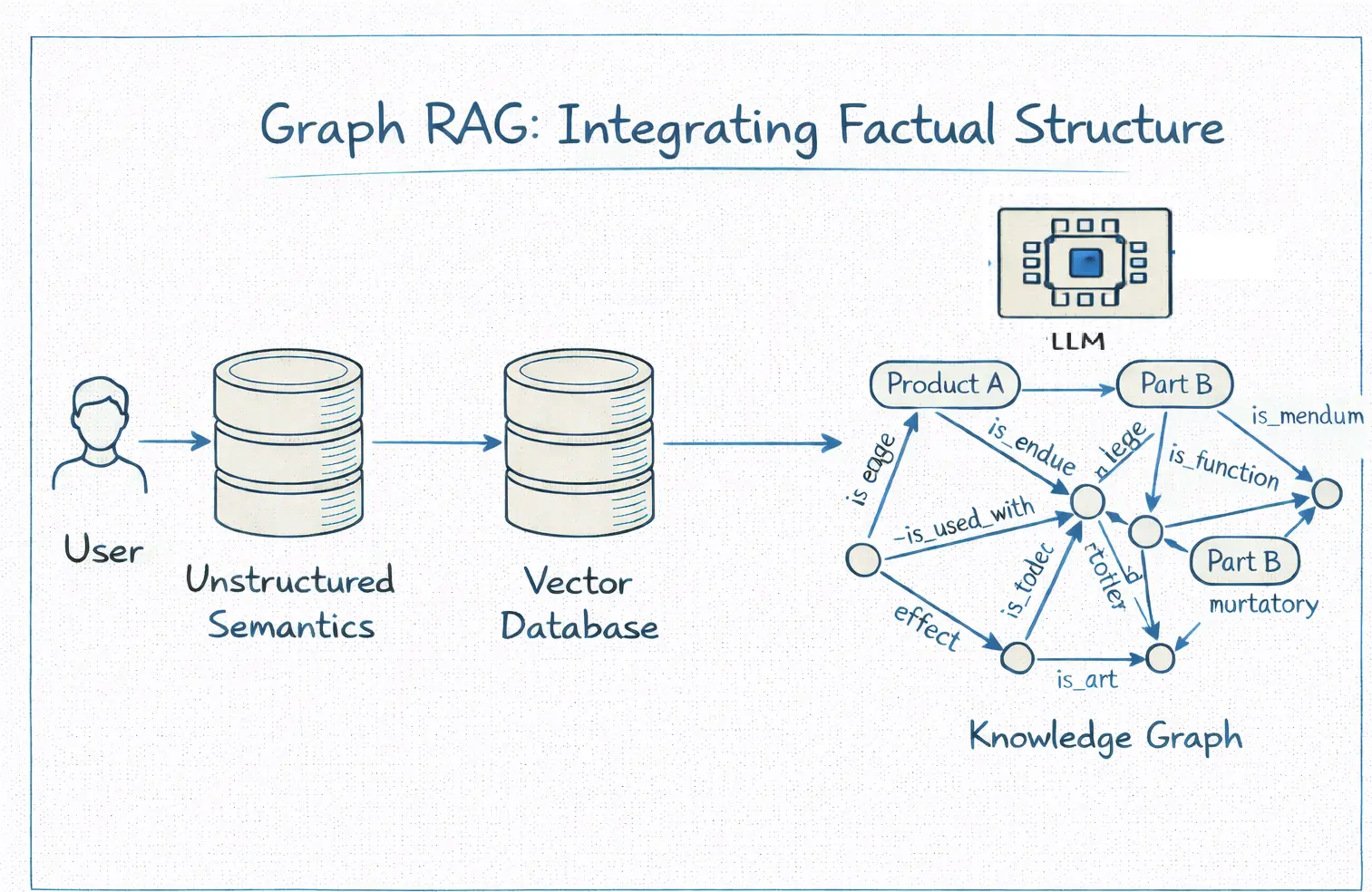
Enterprises do not run on isolated text documents; they run on complex relationships. An invoice is connected to a vendor, which is connected to a risk profile, which is connected to a compliance framework. To answer high-level strategic questions, AI needs to understand these connections. Enter Graph RAG.
The Business Impact
The system is now acting as a cross-functional subject matter expert.
-
The Process: We merge standard text search with a “Knowledge Graph” — a structured map of your business relationships.
-
The Business Value: Precision at scale. Instead of just finding a document that mentions “Supply Chain Risk,” the AI can traverse your business map to answer: “Which of our tier-1 suppliers are impacted by the new European compliance law, and what specific contracts need renegotiation?”
-
The ROI: This is where AI moves from a simple productivity tool to a strategic asset, capable of breaking down data silos and providing holistic enterprise intelligence.
Agentic RAG: Autonomous Workflows
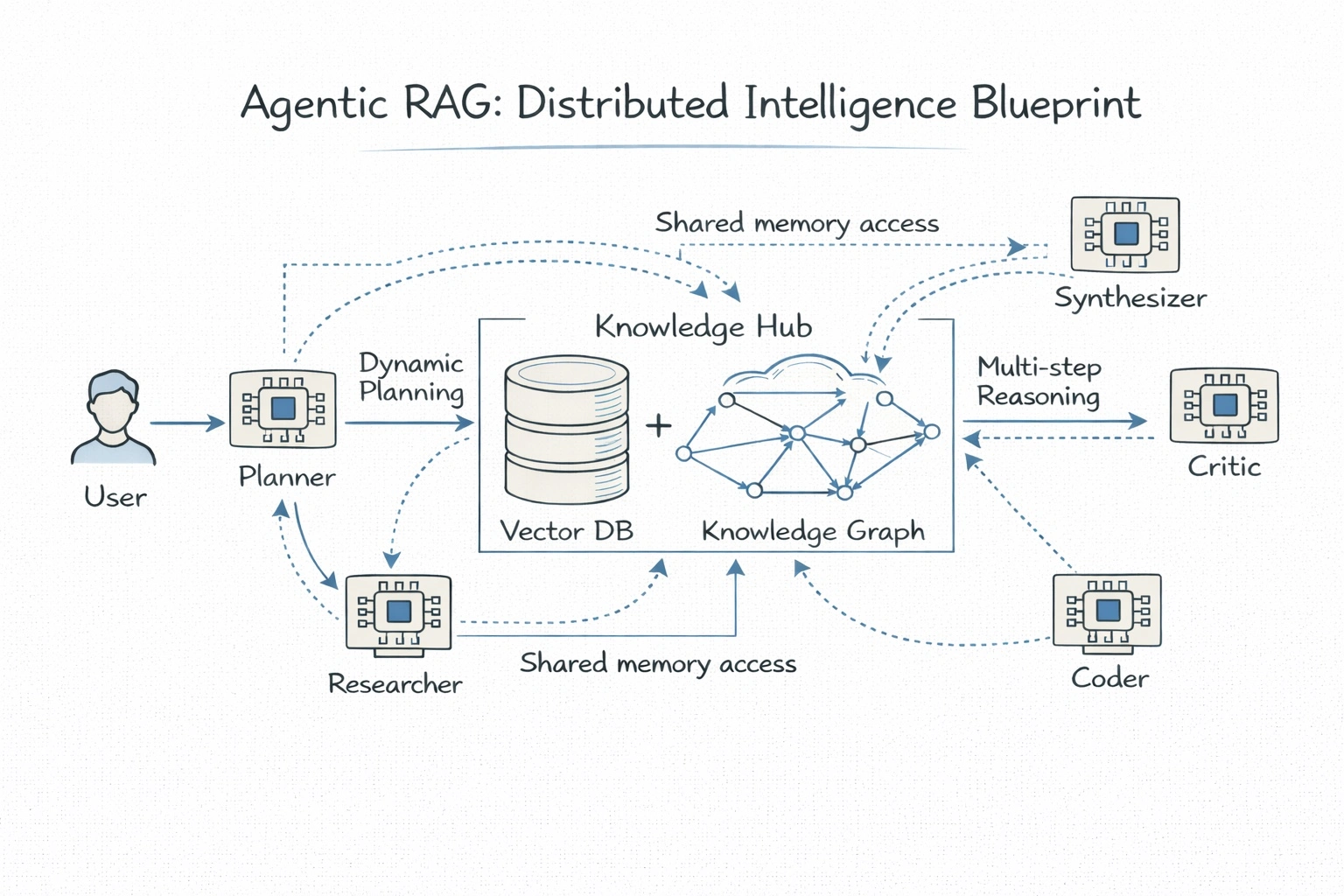
We are currently guiding most of our clients into the Agentic RAG. Here, we stop thinking about AI as a “chatbot” that answers questions, and start thinking about it as a digital workforce that executes complex processes.
The Business Impact
The system operates as a coordinated team of specialists.
-
The Process: Instead of one AI trying to do everything, the system uses multiple specialized AI “agents”:
- A Planner Agent breaks down a massive user request.
- A Researcher Agent hunts for data across your databases.
- A Coder Agent might run a Python script to calculate financial impacts.
- A Critic Agent reviews the final report before presenting it to the human user.
-
The Business Value: End-to-end automation of complex, multi-step knowledge work. You can delegate outcomes, not just queries.
“Draft a comprehensive response to this RFP based on our past winning bids, verify the pricing against our current catalog, and flag any compliance risks for legal review.”
The Executive Takeaway
When evaluating AI investments, the question is no longer “Should we use RAG?”
The question is “Which RAG architecture does this business problem require?”
| Architecture | Analogy | Best For |
|---|---|---|
| Naive RAG | Junior analyst | Internal knowledge bases, FAQs |
| Modular RAG | Analyst with supervisor | Compliance, customer support |
| Graph RAG | Cross-functional SME | Strategic queries, data silo elimination |
| Agentic RAG | Digital workforce | End-to-end workflow automation |
Basic search (Naive RAG) is a commodity. True competitive advantage lies in building systems that can self-correct (Modular RAG), understand your unique business matrix (Graph RAG), and execute multi-step workflows autonomously (Agentic RAG).
Co-Founder & Head of Product