AI-Native Architecture: An Executive Decision Guide
A practical framework for executives on where AI runs, how it accesses enterprise knowledge, when models should be customized, and where automation should stop for human review — starting always with the lightest-cost lever that solves the problem.
Executive Summary
- AI architecture should be treated as a business design choice, not a single technology purchase.
- The most effective organizations apply the lightest-cost architectural lever that solves the problem before moving to more complex options.
- The core executive decisions are where AI runs, how it accesses enterprise knowledge, when models should be customized, and where automation should stop for human review.
- In most cases, the decision sequence should be: optimize prompting, add cached context, add a curated knowledge layer, use RAG only for dynamic data, and fine-tune only for repeatable behavior or footprint constraints.
- Governance is not a final step. Privacy, approval controls, auditability, and model-risk discipline should shape every layer of the stack.
The Executive Lens
Executive and Leadership teams do not need to choose between being ambitious about AI and being disciplined about risk. They do need a practical framework for deciding which architectural choice fits which business problem.
The most common mistake is treating every AI use case as if it requires a large integration program. In practice, many use cases can be addressed with better prompting or a lightweight knowledge layer. More complex approaches create value only when the business need justifies the added cost, operating burden, and control requirements.
Executive takeaway: Start with the simplest architecture that can deliver the required outcome, then add complexity only when the business case is clear.
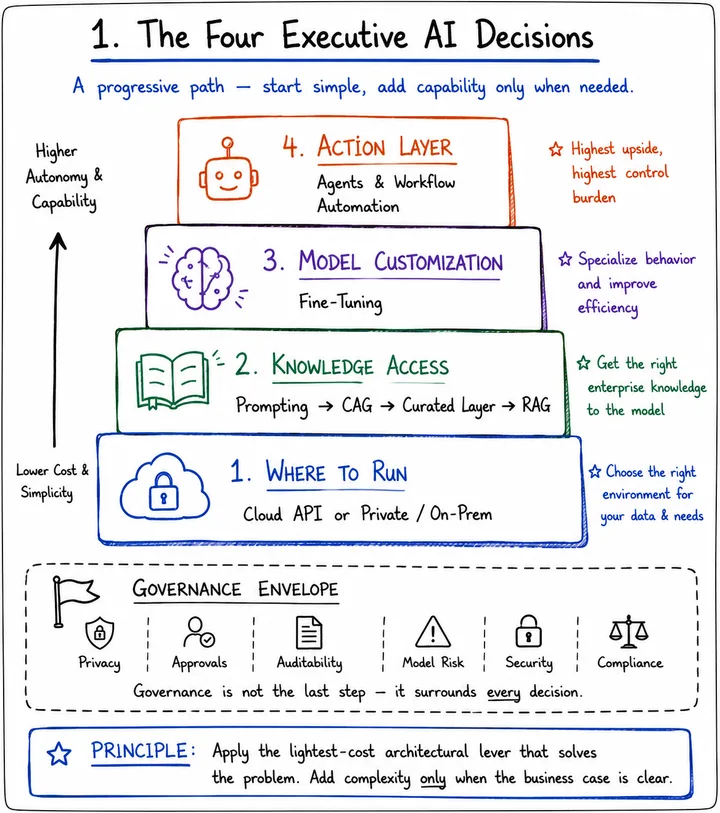
1. Where to Run AI
Cloud API
What it is
Using models hosted by external providers through managed APIs.
When it fits
- Early experimentation
- Broad knowledge work
- Rapid time-to-market initiatives
Business upside
- Fast adoption
- Access to frontier models
- No infrastructure investment
Main risk
Recurring usage costs can scale quickly, and sensitive data handling requires careful legal, security, and vendor review.
Executive takeaway: Cloud-hosted AI is often the right starting point, but it should be governed as an operating expense with explicit data policies.
Private, Edge, or On-Premise Deployment
What it is
Running open-weight or privately hosted models on enterprise-controlled infrastructure.
When it fits
- Sensitive data environments
- Strict residency requirements
- Predictable high-volume workloads
- Low-latency operational settings
Business upside
- Stronger data control
- Predictable economics at scale
- Tighter integration with internal systems
Main risk
Higher implementation complexity, infrastructure ownership, and the need to manage model performance directly.
Executive takeaway: Private deployment is a strategic control decision, not a default optimization.
2. How AI Should Access Knowledge
Prompting: The First Lever
What it is
Improving instructions, structure, and examples without changing the model or adding new infrastructure.
When it fits
The model already has enough general knowledge, but the output is inconsistent or poorly aligned to business needs.
Business upside
- Lowest cost
- Fastest iteration
- Often the highest near-term return
Main risk
Teams may mistake prompting for a complete enterprise knowledge strategy.
Executive takeaway: Before funding larger architecture, confirm the problem cannot be solved with better prompting.
CAG: Cached Context for Stable Knowledge
What it is
Cache-Augmented Generation preloads stable, high-value information into the model context window.
When it fits
- Policy summaries
- Standards
- Playbooks
- Stable reusable knowledge
Business upside
- Simple architecture
- Fast responses
- Low operational overhead
Main risk
It does not scale well to large or frequently changing knowledge sets.
Executive takeaway: Use cached context when the knowledge is durable enough to preload and valuable enough to reuse repeatedly.
Curated Knowledge Layer
What it is
A maintained internal knowledge layer that synthesizes raw documents into concise, reusable assets.
When it fits
Leaders repeatedly need answers derived from large document sets.
Business upside
- Consistent interpretation
- Faster reuse
- Reduced repeated synthesis effort
Main risk
The curation process itself must be governed and continuously maintained.
Executive takeaway: When the same documents are interpreted repeatedly, compile the knowledge once and reuse it many times.
RAG: Retrieval for Dynamic Knowledge
What it is
Retrieval-Augmented Generation retrieves external content at query time and injects selected evidence into the model.
When it fits
- Dynamic operational data
- Frequently changing records
- Large distributed content stores
Business upside
- Better freshness
- Improved grounding
- Connection to changing enterprise reality
Main risk
Poor retrieval design increases latency, cost, and noise.
Executive takeaway: Reserve RAG for information that changes often enough to justify live retrieval.
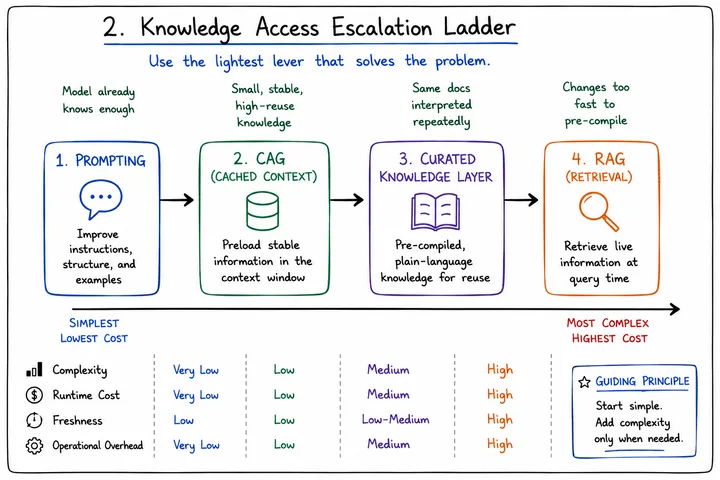
3. When to Customize Models
Fine-Tuning: Behavioral Specialization
What it is
Training a model on curated examples to make its behavior more consistent, efficient, or domain-specific.
When it fits
- Repeatable response patterns
- Smaller-model deployment
- Specialized output behavior
Business upside
- Better consistency
- Lower inference cost in some environments
- Stronger domain alignment
Main risk
Fine-tuning is slower to update than prompts or retrieval layers.
Executive takeaway: Fine-tune for behavior and efficiency — not as a substitute for knowledge access.
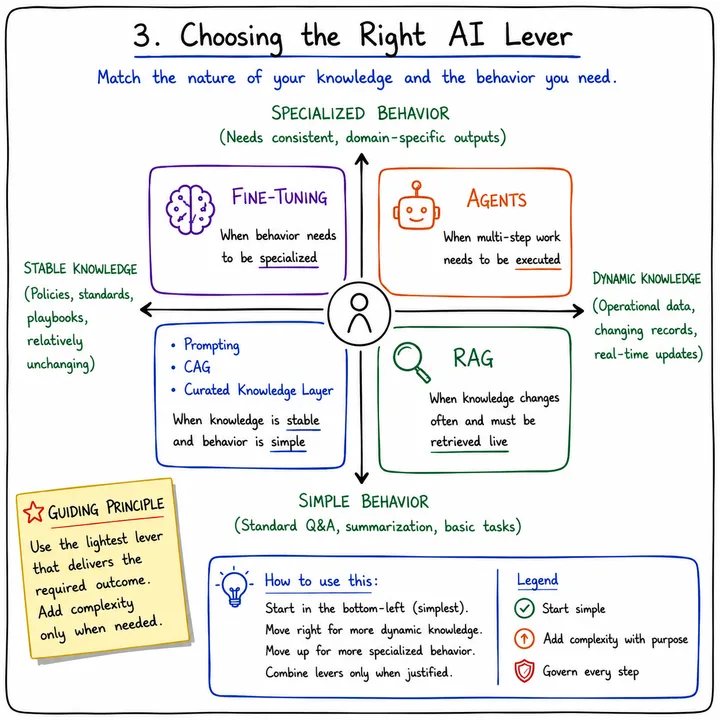
4. Where Agents Fit
Agentic AI: The Action Layer
What it is
Software agents that coordinate tools, workflows, and multi-step tasks across systems.
When it fits
- Workflow orchestration
- Structured repetitive processes
- Clear decision boundaries
Business upside
- Faster cycle times
- Higher productivity
- Operational automation
Main risk
Autonomy amplifies mistakes when approvals and escalation paths are weak.
Executive takeaway: Agents should earn autonomy gradually. In most enterprises, human-approved execution is the preferred model.
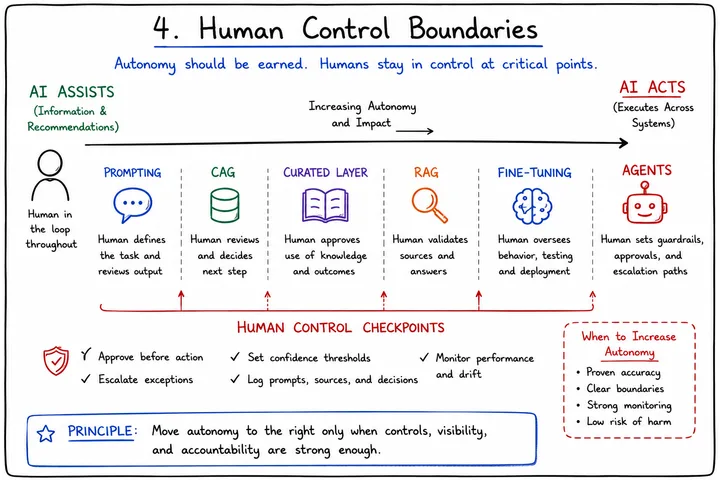
5. What Governance Is Non-Negotiable
Governance should be designed into the architecture from the start rather than attached after deployment.
The critical questions remain consistent across the stack:
- What data is allowed into which model environment?
- Which outputs require human approval?
- How are prompts, sources, and decisions logged?
- Who owns model quality and incident response?
- Which workflows can operate autonomously?
Executive takeaway: Governance is not a separate workstream. It is the operating model that determines whether AI can scale safely.
Executive Decision Matrix
| Lever | Primary Purpose | Best For | Avoid When | Main Tradeoff |
|---|---|---|---|---|
| Prompting | Improve output quality | Early use cases, rapid iteration | Enterprise knowledge is missing | Lowest cost, limited knowledge |
| CAG / Cached Context | Stable reusable knowledge | Policies, standards, playbooks | Content changes frequently | Simple but less dynamic |
| Curated Knowledge Layer | Reuse synthesized enterprise insight | Large recurring document interpretation | Continuous live updates are needed | Higher ingest effort |
| RAG | Dynamic retrieval | Operational and changing data | Simpler approaches are sufficient | Higher runtime complexity |
| Fine-Tuning | Specialized behavior | Domain-specific outputs | Knowledge access is the real issue | Slower updates |
| Agents | Workflow execution | Multi-step orchestration | Controls and approvals are unclear | Highest governance burden |
Closing View
AI-native architecture should not be treated as a race to accumulate tools.It is a sequence of business decisions about cost, control, speed, trust and operational governance. The leadership principle is straightforward:
- Start with prompting
- Add cached or curated knowledge when stable enterprise context is needed
- Use RAG when reality changes too quickly to pre-compile
- Fine-tune when behavior matters
- Introduce agents when workflows are ready for governed automation
The organizations that win with AI will not necessarily be the ones with the most advanced stack. They will be the ones that apply the right level of capability with the right level of control.
Co-Founder & Head of Product